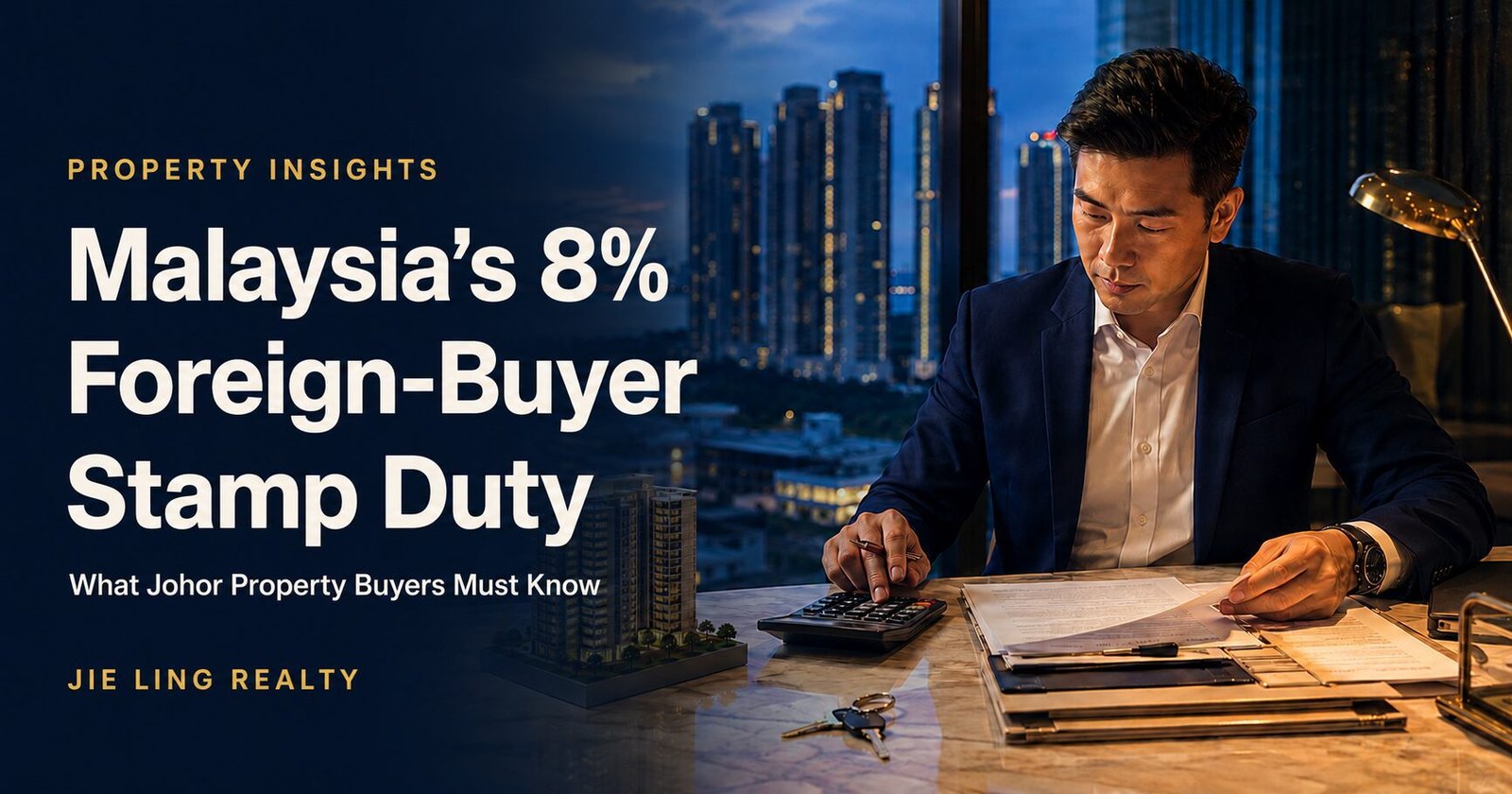
- From 1 January 2026, the stamp duty on an instrument transferring residential property to affected foreign purchasers rose from 4% to 8% — a replacement rate, not an additional charge on top of 4%.
- It applies to non-citizens who are not Malaysian permanent residents, and qualifying foreign companies. Malaysian PRs need separate, individual confirmation.
- Duty is assessed on the higher of purchase consideration or market value — not always simply the SPA price.
- Non-residential property generally remains at the earlier 4% provision — but classification must be verified against the actual title, not the marketing name.
- 自 2026 年 1 月 1 日起,涉及受影响外国买家的住宅产业转让文书印花税,由 4% 上调至 8%——这是替代税率,并非在原有 4% 基础上再加收 8%。
- 适用对象为非马来西亚公民且非马来西亚永久居民者,以及合格的外资公司。马来西亚永久居民须个别单独确认身份。
- 印花税以购买代价与市场价值两者中较高者计算——并非一律以买卖合约上的价格为准。
- 非住宅产业一般仍适用原先的 4% 规定——但产业分类须以实际地契为准核实,而非以营销名称判断。
A Singaporean buyer scrolling listings sees a Johor residential property advertised at RM1 million. Converted into Singapore dollars, the number still looks approachable — well within reach compared to home prices across the Causeway.
一位新加坡买家在浏览房源时,看到一套柔佛住宅标价 100 万令吉。换算成新元后,这个数字看起来仍然可以负担——比堤岸对岸的房价亲民得多。
But the advertised price is not the full entry cost.
但标价并非完整的入手成本。
Under a rule that took effect on 1 January 2026, an affected foreign purchaser acquiring that same property could face RM80,000 in stamp duty on the transfer instrument alone — assuming RM1 million is also the relevant assessable value. That is a simplified illustration, not a transaction quotation: the actual duty depends on the higher of the purchase consideration or market value, on the purchaser's legal status, and on the specific transaction circumstances.
根据 2026 年 1 月 1 日起生效的新规,若受影响的外国买家购买这套房产,单是转让文书的印花税就可能高达 8 万令吉——前提是 100 万令吉也是相关的应课税价值。这只是简化示例,并非交易报价:实际税额取决于购买代价与市场价值两者中较高者、买家的法律身份,以及具体交易情况。
Still, it points to something every buyer of Johor property from outside Malaysia should understand before paying a booking fee. This is the reality behind Malaysia's foreign buyer stamp duty 2026 change — and it's the first number worth calculating, not the last.
但这也说明了一件事:每一位来自马来西亚境外、有意购买柔佛房产的买家,都应在支付订金之前先弄清楚这一点。这就是马来西亚 2026 年外国买家印花税调整背后的现实——而这,是您该计算的第一个数字,而不是最后一个。
What Changed on 1 January 2026?2026 年 1 月 1 日发生了什么变化?
Malaysia's Finance Act 2025 and related legislation, gazetted on 31 December 2025, took effect on 1 January 2026. Among the changes: the stamp duty rate that generally applies to an instrument transferring residential property to certain foreign purchasers rose from 4% to 8%.
马来西亚《2025 年财政法案》及相关法规,已于 2025 年 12 月 31 日刊宪,并自 2026 年 1 月 1 日起生效。其中一项变化:涉及特定外国买家的住宅产业转让文书,其一般适用的印花税率由 4% 上调至 8%。
Before 1 January 2026, affected foreign purchasers were generally subject to a flat 4% rate, in force since 1 January 2024. From 1 January 2026, the rate for qualifying transfers is 8%. This effectively doubled the transfer-duty rate for affected foreign residential-property purchasers.
在 2026 年 1 月 1 日之前,受影响的外国买家一般适用统一 4% 税率,该税率自 2024 年 1 月 1 日起施行。自 2026 年 1 月 1 日起,符合条件的转让适用 8% 税率。这实际上使受影响外国住宅买家的转让印花税率翻倍。
Who Is Subject to the 8% Rate?谁须缴付 8% 税率?
The 8% rate generally applies to an instrument transferring residential property to:
8% 税率一般适用于将住宅产业转让予以下人士的文书:
- A person who is not a Malaysian citizen and not a Malaysian permanent resident
- A qualifying foreign company, as defined under the applicable legislation
- 非马来西亚公民且非马来西亚永久居民者
- 根据相关法规界定的合格外资公司
"Foreigner" is too broad a word to use without qualification here, and the details matter:
"外国人"一词在这里过于笼统,细节至关重要:
- Malaysian permanent residents require separate consideration — PR status should not be assumed to automatically place a buyer inside or outside the affected group without professional confirmation.
- Joint purchases require transaction-specific assessment. LHDN's Budget 2026 clarification indicates duty for joint ownership may be assessed according to each liable party's share and circumstances.
- A Malaysian citizen buying jointly with a foreign spouse should not assume the entire transaction will automatically be treated in one simple way.
- Buyers should obtain a written calculation from their conveyancing lawyer before committing to a purchase.
- 马来西亚永久居民须个别考量——不应在未经专业确认的情况下,假设 PR 身份就自动使买家落入或排除在受影响群体之外。
- 联名购买须按具体交易个别评估。根据大马内陆税收局(LHDN)就 2026 年财政预算案的澄清,联名持有的印花税可能按各责任方的持份与情况分别评估。
- 与外籍配偶联名购买的马来西亚公民,不应假设整宗交易会自动以单一简单方式处理。
- 买家应在承诺购买前,向产业律师索取书面税额计算。
For a broader look at the costs foreign buyers face beyond stamp duty, see our Foreigner's Guide to Buying Property in Malaysia.
若想更全面了解外国买家在印花税以外须承担的成本,请参阅我们的《外国人购房指南》。
What Counts as Residential Property?什么算是住宅产业?
The statutory residential-property definition being inserted into the Stamp Act includes:
即将纳入《印花税法令》的法定住宅产业定义包括:
- House
- Condominium
- Apartment
- Flat
- Serviced apartment
- Small office home office (SOHO)
- 排屋/独立式住宅
- 共管公寓(Condominium)
- 公寓(Apartment)
- 组屋式公寓(Flat)
- 服务式公寓
- 小型家庭办公室(SOHO)
To qualify, the property must fall within the applicable statutory definition and be used solely as a dwelling house.
要符合资格,该产业须落入相关法定定义范围内,并且仅作为住宅用途使用。
Here is where buyers get caught off guard: a project built on land described as commercial, or marketed under a commercial title, does not automatically mean the residential-transfer rule is irrelevant. Likewise, a unit marketed as a "residence" does not, by itself, determine its legal tax treatment. Classification depends on the property's actual legal documents and permitted use — not its marketing name — and should be verified with a lawyer.
这正是买家最容易被误导之处:一个建在商业地契上、或以商业地契销售的项目,并不代表住宅转让规则就自动与其无关。同样地,一个以"住宅"名义销售的单位,其名称本身也不能决定其法律税务待遇。产业分类取决于实际的法律文件与批准用途——而非营销名称——应向律师核实。
How Is the 8% Stamp Duty Calculated?8% 印花税如何计算?
The 8% duty is generally imposed on the higher of the purchase consideration or the property's market value, subject to assessment and the applicable transaction circumstances — not always simply 8% of the figure printed on the Sale and Purchase Agreement.
8% 印花税一般按购买代价与产业市场价值两者中较高者征收,并须视评税与具体交易情况而定——并非一律以买卖合约上所列金额乘以 8% 计算。
Three simplified illustrations, each a demonstration of the mechanism, not a transaction quotation:
以下三个简化示例,仅用于说明计算机制,并非交易报价:
- Example 1 — purchase consideration and accepted market value both RM1,000,000: RM1,000,000 × 8% = RM80,000.
- Example 2 — relevant assessable value RM1,500,000: RM1,500,000 × 8% = RM120,000.
- Example 3 — purchase consideration RM1,000,000, assessed market value RM1,100,000: the higher figure is used, so illustratively RM1,100,000 × 8% = RM88,000.
- 示例一——购买代价与认可市场价值均为 100 万令吉:100 万令吉 × 8% = 8 万令吉。
- 示例二——相关应课税价值为 150 万令吉:150 万令吉 × 8% = 12 万令吉。
- 示例三——购买代价 100 万令吉,评定市场价值 110 万令吉:以较高者计算,即 110 万令吉 × 8% = 8.8 万令吉。
Before and After the 2026 Change2026 年调整前后对比
These illustrations assume the stated property value is also the relevant assessable value:
以下示例假设所列产业价值即为相关应课税价值:
| Property Value产业价值 | Previous 4% Rate原 4% 税率 | New 8% Rate新 8% 税率 | Difference差额 |
|---|---|---|---|
| RM1,000,000 | RM40,000 | RM80,000 | RM40,000 |
| RM1,500,000 | RM60,000 | RM120,000 | RM60,000 |
| RM2,000,000 | RM80,000 | RM160,000 | RM80,000 |
These simplified examples assume the stated property value is the relevant assessable value and that no exemption, remission or special treatment applies. They are not a quotation for any specific transaction.以上简化示例假设所列产业价值即为相关应课税价值,且不涉及任何豁免、减免或特殊待遇,并非针对任何具体交易的报价。
Does It Apply to New Launch and Subsale Property?新楼盘与二手房也适用吗?
The relevant tax is stamp duty on the instrument of transfer or conveyance — not on viewing a unit, paying a booking fee, signing an expression of interest, or receiving a sales quotation. Those earlier steps are not, by themselves, the taxable event.
相关税务针对的是转让或产权移转文书——而非看房、支付订金、签署意向书或收到销售报价单。这些较早的步骤本身并非应课税事件。
The rule can be relevant to residential-property transfers arising from both new-launch and subsale purchases, but the precise timing of the transfer instrument may differ between the two. A new-launch buyer may sign a Sale and Purchase Agreement well before the eventual transfer is registered and assessed. Do not assume every new-launch buyer pays the transfer duty immediately upon signing the SPA — confirm the actual instrument and assessment timing with a conveyancing lawyer. Our comparison of new launch versus subsale property in Johor looks at these timeline differences in more detail.
这项规定可能适用于新楼盘与二手房交易所产生的住宅产业转让,但两者转让文书的确切时间点可能有所不同。新楼盘买家可能在正式转让登记与评税之前,早已签署买卖合约。请勿假设所有新楼盘买家都会在签署合约当下立即缴付转让印花税——应向产业律师核实实际文书与评税时间。我们对柔佛新楼盘与二手房的比较,详细探讨了这些时间差异。
Does It Apply to Serviced Apartments and SOHO Units?服务式公寓与 SOHO 单位也适用吗?
This is a point that surprises many buyers: the statutory residential-property definition can include serviced apartments and SOHO units, provided they are used solely as a dwelling house. A serviced apartment marketed under a commercial development is not automatically outside the residential-property definition simply because of how it is branded.
这一点常令许多买家意外:法定住宅产业定义可涵盖服务式公寓与 SOHO 单位,只要它们仅作住宅用途使用。以商业发展项目名义销售的服务式公寓,不会仅因营销包装而自动被排除在住宅产业定义之外。
Buyers should not rely only on the project brochure, the developer's marketing category, the words "commercial title" on a flyer, the project name, or an informal verbal explanation. Request written confirmation from a lawyer, based on the actual title documents and the statutory definition, before assuming a serviced apartment or SOHO unit sits outside this rule.
买家不应仅凭项目宣传册、发展商的营销分类、传单上的"商业地契"字样、项目名称,或非正式的口头说明作判断。在假设某服务式公寓或 SOHO 单位不受此规定约束之前,应根据实际地契文件与法定定义,向律师索取书面确认。
Is Commercial Property Still Charged at 8%?商业产业仍按 8% 征税吗?
The 8% rule is specifically directed at residential property within the statutory definition. Based on LHDN's Budget 2026 clarification, the relevant 4% provision generally continues to apply to non-residential property transferred to affected foreign purchasers.
8% 规定专门针对法定定义内的住宅产业。根据大马内陆税收局就 2026 年财政预算案的澄清,转让予受影响外国买家的非住宅产业,一般仍适用原有的 4% 条文。
That said, this is not a reason to select commercial property purely to obtain a lower duty rate. Commercial property can involve different financing terms, different taxes, different utility tariffs, use restrictions, vacancy risk and a different tenant market altogether. The legal classification and permitted use of any specific unit must still be verified before a purchase decision is made.
话虽如此,这并非单纯为了取得较低税率而选择商业产业的理由。商业产业可能涉及不同的融资条件、不同的税务、不同的水电收费、使用限制、空置风险,以及截然不同的租户市场。在作出购买决定前,仍须核实具体单位的法律分类与批准用途。
The RM1 Million Property Does Not Cost Only RM1 Million100 万令吉的房子,不会只花 100 万令吉
Purchase price: RM1,000,000. Once the transfer duty is added, that number already understates the entry cost — and the duty is not the only additional item on the list. Possible additional costs can include:
购买价格:100 万令吉。一旦加上转让印花税,这个数字就已经低估了实际入手成本——而印花税还不是唯一的额外项目。可能涉及的其他成本包括:
- Transfer stamp duty
- State consent fees or foreign-purchaser levies
- Legal fees and disbursements
- Loan documentation costs and stamp duty on financing instruments
- Valuation fees
- Insurance
- Renovation
- Furniture and appliances
- Maintenance and utility deposits
- 转让印花税
- 州政府批准费或外国买家征费
- 律师费与杂项支出
- 贷款文件费用及融资文书印花税
- 估价费
- 保险
- 装修
- 家具与电器
- 维修基金与水电按金
Is Johor Property Still Affordable for Singaporeans?柔佛房产对新加坡人来说还负担得起吗?
The honest answer is balanced, not a sales pitch either way. The Singapore dollar can still provide meaningful purchasing-power advantages when buying across the Causeway, and Johor's entry prices may remain lower than comparable Singapore residential property. Those are real factors.
诚实的答案是持平的,而非任何一方的推销说辞。新元在堤岸对岸置业时,仍可能提供实质的购买力优势,柔佛的入门价格也可能低于新加坡同类住宅产业。这些都是真实的因素。
But an exchange-rate conversion alone is an incomplete affordability test. The new duty increases the upfront capital a foreign buyer must commit, and affordability on paper does not automatically make a property a good investment. Rental demand, location, ongoing ownership expenses, holding period and exit options remain just as important as before. The comparison that matters is total cost against total cost — not headline price against headline price.
但单凭汇率换算并不是完整的负担能力测试。新税率增加了外国买家须预先投入的资金,而纸面上的负担能力,并不代表这就是一项好的投资。租赁需求、地点、持有期间的持续开销、持有期长短与退场选择,仍然同样重要。真正重要的比较,是总成本对总成本——而非标价对标价。
How the New Duty Can Affect Investment Returns新税率如何影响投资回报
A larger acquisition cost increases the total capital an investor has committed to a property, even if the purchase price itself hasn't moved. A higher entry cost can reduce the return calculated on total cash invested rather than on the SPA price alone; a longer holding period may be needed to recover the additional transaction cost; and a short-term resale strategy becomes more sensitive to both entry and exit expenses.
即使购买价格本身没有变动,更高的购置成本也会增加投资者投入该产业的总资金。较高的入手成本,可能降低以总投入现金(而非仅买卖合约价格)计算的回报率;可能需要更长的持有期才能弥补额外的交易成本;短期转售策略也会对进出成本更加敏感。
Consider a simple illustrative framework. Purchase price RM1,000,000, annual gross rent RM48,000. Yield calculated only against the purchase price: RM48,000 ÷ RM1,000,000 × 100 = 4.8%. If total invested capital is higher once duty and other acquisition costs are included, the gross return calculated on that total capital will be lower than 4.8% — though the exact revised figure depends on hypothetical total costs this article has deliberately not invented. Run your own numbers with your lawyer and financing sources once you know the actual figures for your transaction.
试想一个简单的示意框架。购买价格 100 万令吉,年租金总收入 4.8 万令吉。仅以购买价格计算的回报率:4.8 万令吉 ÷ 100 万令吉 × 100 = 4.8%。若计入印花税与其他购置成本后总投入资金更高,则以总投入资金计算的毛回报率将低于 4.8%——但确切的修正数字,取决于本文刻意未虚构的假设性总成本。待您知悉交易的实际数字后,请与您的律师及融资机构一同核算。
Can a Developer Rebate Remove the Stamp Duty?发展商回扣能免除印花税吗?
A developer promotion or rebate may offset part of a buyer's economic cost, but it does not necessarily change the statutory duty calculation itself. The duty may still be assessed using the higher of the purchase consideration or market value, regardless of what a rebate advertises.
发展商的促销或回扣,或许能抵消买家部分的经济成本,但未必会改变法定的税额计算方式本身。无论回扣广告如何宣传,印花税仍可能按购买代价与市场价值两者中较高者评定。
Before relying on any incentive, get its terms in writing and confirm exactly what it covers: is the developer paying the duty directly, reimbursing the buyer, or simply advertising a benefit that does not change what LHDN assesses? The legal duty obligation and the commercial rebate are two separate issues.
在依赖任何优惠之前,请取得书面条款,并确认其具体涵盖范围:是发展商直接代付印花税、报销给买家,还是仅仅是一项不会改变内陆税收局评税结果的宣传优惠?法定的纳税义务与商业回扣,是两回事。
What About Buying With a Malaysian Spouse?与马来西亚籍配偶联名购买呢?
Joint ownership involving parties with different citizenship or residency status requires individual, transaction-specific assessment — there is no single universal answer. LHDN's clarification indicates that duty may be assessed according to the liable parties and their respective ownership shares. Buyers should not assume that simply adding a Malaysian spouse to the transaction automatically removes the foreign-buyer rate from the whole purchase. Ownership shares, beneficial ownership, financing arrangements and the legal consequences of each structure all need proper, individual professional advice.
涉及不同公民身份或居留状态各方的联名持有,须按个别交易分别评估——并没有单一放诸四海皆准的答案。根据内陆税收局的澄清,印花税可能按各责任方及其各自持份分别评定。买家不应假设,仅仅在交易中加入马来西亚籍配偶,就能自动使整宗交易免除外国买家税率。持股比例、实益拥有权、融资安排以及各种架构的法律后果,都需要个别、恰当的专业意见。
Questions Foreign Buyers Should Ask Before Paying a Booking Fee外国买家在支付订金前应提出的问题
Keep this on your phone. Run through it before you sign anything.
把这份清单存在手机里,在签署任何文件前逐项核对。
Am I treated as a non-citizen, permanent resident or another category?我会被归类为非公民、永久居民,还是其他身份?
Is the property legally treated as residential property?该产业在法律上是否被视为住宅产业?
Is it a serviced apartment or SOHO used solely as a dwelling?是否属于仅作住宅用途的服务式公寓或 SOHO?
What is the expected assessable value?预期的应课税价值是多少?
Which instrument will attract the transfer duty?哪一份文书须缴付转让印花税?
When is that instrument expected to be submitted for assessment?该文书预计何时提交评税?
Does the purchase involve state consent?此次购买是否涉及州政府批准?
Are foreign-purchaser levies or administrative charges applicable?是否涉及外国买家征费或行政费用?
What legal fees and disbursements should I budget?应预留多少律师费与杂项支出?
Will I obtain financing?我是否会申请贷款?
What separate stamp duty applies to the financing documents?融资文件须另外缴付什么印花税?
Is any developer incentive written into the official documents?发展商的优惠是否已写入正式文件?
Who is legally paying each cost?每一项费用在法律上由谁支付?
Is the purchase joint with a Malaysian citizen or permanent resident?此次购买是否与马来西亚公民或永久居民联名?
Can my lawyer provide a written total-cost estimate?我的律师能否提供书面的总成本估算?
The Five Documents Buyers Should Request买家应索取的五份文件
- Draft Sale and Purchase Agreement — sets out the actual purchase consideration, parties and conditions your lawyer will assess duty against.
- Title or relevant title information — confirms the property's legal classification and permitted use, not just its marketing name.
- Written fee and disbursement quotation — itemises legal fees and other professional costs so they aren't a surprise later.
- State-consent and foreign-purchase requirement explanation — clarifies whether state consent or additional levies apply to this specific transaction.
- Written estimated stamp-duty calculation — a transaction-specific figure from your lawyer, not a generic online estimate.
- 买卖合约草稿——列明实际购买代价、各方与条件,供律师据此评估印花税。
- 地契或相关地契资料——确认产业的法律分类与批准用途,而非仅凭营销名称。
- 书面费用与支出报价单——逐项列明律师费与其他专业费用,避免日后意外。
- 州政府批准与外国购买要求说明——厘清此宗交易是否涉及州政府批准或额外征费。
- 书面印花税估算——由您的律师提供、针对该交易的具体数字,而非笼统的网上估算。
These five documents support due diligence; they do not replace it — full professional advice covering the whole transaction is still necessary.
这五份文件有助于尽职调查,但不能取代它——仍须就整宗交易寻求全面的专业意见。
For foreign buyers, the most important question is no longer simply, "What is the property price?" The better question is: "After transfer duty, state requirements, professional fees, financing and preparation costs, how much capital will I actually need to own this property?" Understanding that figure before paying a booking fee can prevent an attractive property price from becoming an unexpected financial commitment later.
对外国买家而言,最重要的问题不再只是"这套房子多少钱?",而应该是:"扣除转让印花税、州政府要求、专业费用、融资与前期准备成本后,我实际需要多少资金才能拥有这套产业?"在支付订金之前弄清楚这个数字,能避免一个吸引人的标价,日后变成意料之外的财务负担。
Considering a Johor Property?正在考虑柔佛房产?
Considering a Johor property as a Singaporean or overseas buyer? Book a private property consultation with Jie Ling Realty to compare suitable properties and understand the questions you should raise with your lawyer before committing to a purchase.作为新加坡或海外买家,正在考虑柔佛房产?预约 Jie Ling Realty 的私人置业咨询,比较合适的房产选择,并了解在承诺购买前应向律师提出哪些问题。
Book a Property Consultation预约置业咨询Frequently Asked Questions常见问题
What is Malaysia's foreign-buyer property stamp-duty rate in 2026?2026 年马来西亚外国买家产业印花税率是多少?
From 1 January 2026, an instrument transferring residential property to certain foreign purchasers is generally subject to an 8% stamp-duty rate, up from the previous 4% rate. This is a replacement rate, not an additional charge on top of 4%.自 2026 年 1 月 1 日起,将住宅产业转让予特定外国买家的文书,一般须缴付 8% 印花税,较原先的 4% 上调。这是替代税率,并非在 4% 基础上另加收费。
Does the 8% stamp duty apply to Singaporeans buying Johor property?8% 印花税是否适用于购买柔佛房产的新加坡人?
It can apply to a Singaporean buyer who is not a Malaysian citizen or permanent resident, purchasing residential property within the statutory definition. The exact treatment depends on the purchaser's status and the specific transaction, so a written calculation from a conveyancing lawyer is recommended before committing.若新加坡买家并非马来西亚公民或永久居民,购买属法定定义内的住宅产业,则可能适用。确切待遇取决于买家身份与具体交易,建议在承诺购买前,向产业律师索取书面计算。
Does the 8% rate apply to Malaysian permanent residents?8% 税率适用于马来西亚永久居民吗?
Malaysian permanent residents require separate consideration and should not be assumed to fall automatically within this foreign-purchaser rate. Status should be confirmed for the specific transaction.马来西亚永久居民须个别考量,不应假设自动适用此外国买家税率。应针对具体交易确认身份。
Are serviced apartments subject to the 8% foreign-buyer rate?服务式公寓须缴付 8% 外国买家税率吗?
They can be, if the unit falls within the statutory residential-property definition and is used solely as a dwelling house — even if the development is marketed as a commercial-title project. Verify the actual classification with a lawyer rather than relying on marketing material.若单位属于法定住宅产业定义范围且仅作住宅用途,即使该项目以商业地契名义销售,仍可能适用。应向律师核实实际分类,而非依赖营销材料。
Is stamp duty calculated from the purchase price or market value?印花税是按购买价格还是市场价值计算?
Generally, the duty is assessed on the higher of the purchase consideration or the property's market value, subject to assessment and the applicable transaction circumstances — not always simply the price on the Sale and Purchase Agreement.一般而言,印花税按购买代价与产业市场价值两者中较高者评定,并须视评税与具体交易情况而定——并非一律以买卖合约上的价格为准。
Does the 8% rate apply to commercial property?8% 税率适用于商业产业吗?
Based on LHDN's Budget 2026 clarification, the relevant 4% provision generally continues to apply to non-residential property transferred to affected foreign purchasers, though classification should always be verified for the specific property.根据内陆税收局就 2026 年财政预算案的澄清,转让予受影响外国买家的非住宅产业,一般仍适用原有的 4% 条文,惟仍应就具体产业核实其分类。
How much is the duty on a RM1 million residential property?100 万令吉住宅产业须缴多少印花税?
As an illustration only, if both the purchase consideration and the relevant assessable value are RM1,000,000, the duty would be RM1,000,000 × 8% = RM80,000. Actual figures depend on the transaction and should be confirmed with a lawyer.仅作示意:若购买代价与相关应课税价值均为 100 万令吉,印花税即为 100 万令吉 × 8% = 8 万令吉。实际数字视交易而定,应向律师核实。
Does a foreign buyer pay the duty when signing the SPA?外国买家是在签署买卖合约时缴税吗?
Not necessarily. The duty applies to the instrument of transfer or conveyance, and the timing of that instrument can differ from the SPA signing date, particularly for new-launch purchases. Confirm the specific timeline with a conveyancing lawyer.不一定。印花税适用于转让或产权移转文书,其时间点可能与买卖合约签署日不同,新楼盘购买尤其如此。应向产业律师核实具体时间表。
Sources资料来源
- LHDN — Compilation of Questions and Answers, National Tax Seminar for Budget 2026 (primary official source)(官方主要来源)
- KPMG Malaysia — Malaysia Tax Measures, Finance Act 2025
- Skrine — Proposed Amendments to the Stamp Act
- PwC Malaysia — Stamp Duty
Information and figures are based on the cited sources and publication dates. Policies, prices and market conditions may change.资料与数据以文中引用来源及发布日期为依据。政策、价格与市场情况可能随时变化。